
What is Ethics?
Why it matters?
Teachers with strong Intelligent-Ethics can promote transparency by making AI use visible to students and stakeholders.
They ensure accountability, taking responsibility for AI-supported decisions and outputs.
They foster fairness and inclusiveness, preventing bias, exclusion, or harm in AI-enhanced classrooms.
They help students develop critical awareness of ethical issues, preparing them for responsible AI use in learning and beyond.
Definition
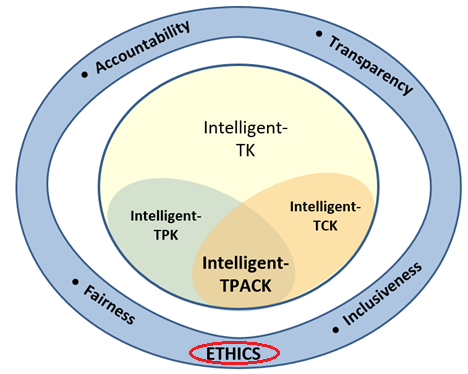
Intelligent-Ethics refers to teachers’ knowledge of evaluating and applying AI tools in line with ethical principles. It includes awareness of transparency, accountability, fairness, and inclusiveness, and the ability to ensure that AI-supported teaching and learning is safe, equitable, and responsible (Celik, 2023).
*The light blue outer layer highlights Intelligent-Ethics and its subdimensions.
(Ethical Knowledge)
Classroom Examples for Intelligent-Ethics
Reflection Questions for Intelligent-Ethics
When an AI grading tool suggests scores, the teacher reviews and adjusts them, documenting why changes were made before sharing results with students.
A language teacher checks AI-generated reading passages for cultural or gender bias, revising the text to ensure representation and inclusivity.
A preservice teacher designs an activity where students compare AI outputs with human-written texts and discuss which is more reliable and why.


How do I take responsibility for checking and validating AI-generated outputs before sharing them with learners?
Am I aware of potential biases in AI outputs, and do I actively check for fairness and representation?
How do I ensure that AI tools are inclusive and accessible for all students, including those with different learning needs or backgrounds?
Do I encourage students to reflect critically on the ethical implications of using AI in their own learning?